





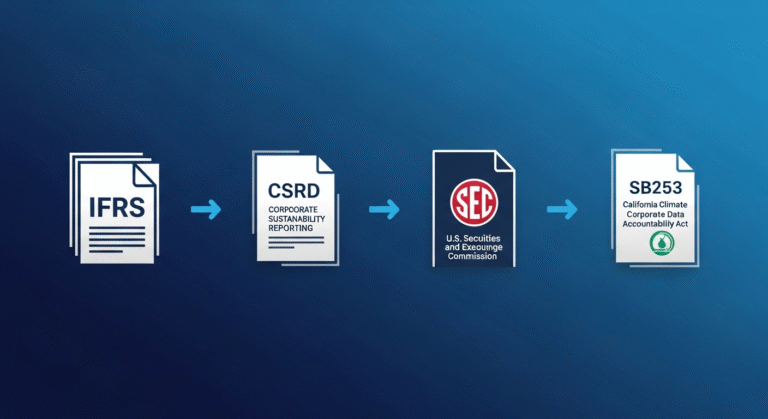
Four major sustainability reporting frameworks now compete for corporate attention, and not one of them aligns perfectly with the others. By most estimates, over 50,000 companies worldwide fall under at least one mandatory climate disclosure regime. Many large multinationals are subject to two or three simultaneously.
If you’ve been trying to track which framework requires what, you’re not alone. The rules have shifted dramatically in the past 12 months. The SEC walked away from its climate rule. The EU slashed its scope by 90%. California forged ahead with the most aggressive state-level law in the US. And the ISSB’s standards keep gaining global traction.
This guide breaks down each framework, compares them side by side, and shows you where they overlap. No jargon spiraling. Just a clear map through the regulatory maze.
- IFRS S1/S2 is the global baseline, adopted or in progress across 30+ jurisdictions.
- EU CSRD/ESRS remains the broadest regime, requiring double materiality assessment.
- The SEC Climate Disclosure Rule is effectively dead, with no federal US mandate.
- California’s SB 253 is the most aggressive US climate law, covering 4,159+ entities with mandatory Scope 1, 2, and 3 reporting by August 2026.
Why Are There So Many Sustainability Reporting Frameworks?
By most estimates, over 50,000 companies now face mandatory sustainability disclosure under at least one regime. The patchwork exists because regulators in different jurisdictions moved at different speeds, with different priorities, and never coordinated a single global standard.
The result? Three distinct materiality approaches running in parallel. IFRS uses financial materiality only. The EU requires double materiality, meaning companies must report both how sustainability issues affect their finances and how their operations affect the world. California’s SB 253 skips the materiality question entirely for emissions, requiring disclosure regardless.
For companies operating across borders, this creates a real compliance headache. You can’t simply file one report and satisfy everyone. But here’s the good news: the underlying data requirements overlap significantly. Understanding each framework’s quirks is the first step toward building a unified approach.
What Are IFRS S1 and S2, and Why Do They Matter?
The International Sustainability Standards Board (ISSB) published IFRS S1 and S2 in June 2023, and over 30 jurisdictions have since committed to adopting them (IFRS Foundation, 2025). These standards represent the closest thing we have to a global sustainability reporting baseline.
S1: General Sustainability Disclosures
IFRS S1 covers all sustainability-related risks and opportunities that could reasonably affect a company’s cash flows, access to financing, or cost of capital. It’s broad by design. Think of it as the umbrella standard covering governance, strategy, risk management, and metrics across every ESG topic.
The critical word here is “financial materiality.” S1 only requires disclosure of sustainability issues that matter to investors. If a topic doesn’t affect your financial prospects, it’s technically out of scope. That’s a deliberate choice, and it’s the biggest philosophical difference from the EU approach.
S2: Climate-Specific Disclosures
IFRS S2 drills into climate specifically. It’s built directly on the TCFD framework, so if your company already reports under TCFD, you’re halfway there. S2 requires Scope 1 and 2 emissions disclosure, and it asks for Scope 3 with a one-year grace period for most adopters.
Here’s a distinction that many summaries miss: the ISSB doesn’t enforce anything. It publishes standards. Individual countries and jurisdictions decide whether and how to adopt them. That means “ISSB adoption” looks different in the UK, Japan, Brazil, Nigeria, and Australia. Local regulators can modify, phase in, or add requirements on top of the baseline.
How Does the EU CSRD/ESRS Compare?
The EU’s Corporate Sustainability Reporting Directive remains the most comprehensive disclosure regime on the planet, even after the Omnibus simplification adopted in February 2026 reduced its scope from roughly 50,000 companies to fewer than 10,000, roughly 80% fewer companies (European Commission, Omnibus simplification directive, 2026). That’s a dramatic reduction, but the depth of reporting hasn’t been diluted.
CSRD vs ESRS: What’s the Difference?
This trips people up constantly. CSRD is the law. It’s the EU directive that mandates sustainability reporting. ESRS is the detailed reporting standard, the rulebook companies actually follow. Think of CSRD as the mandate telling you “you must report” and ESRS as the instruction manual telling you “here’s exactly what to report and how.”
Double Materiality: The EU’s Defining Feature
Double materiality is what makes the EU regime unique. Companies must report in two directions: how sustainability issues affect their business (financial materiality, same as ISSB) AND how their business affects people and the environment (impact materiality). No other major framework requires both.
Does this make reporting harder? Absolutely. But it also produces richer, more complete disclosures. Environmental organizations and civil society groups have championed this approach as the gold standard for corporate transparency.
Post-Omnibus Reality
The EU Omnibus package changed the game significantly. The phased rollout continues, but the number of in-scope companies dropped dramatically. Limited assurance is now the standard; the earlier plan for reasonable assurance was dropped. For companies still in scope, ESRS requirements remain demanding, covering climate, pollution, water, biodiversity, workforce, communities, and governance.
The roughly 80% scope reduction means many mid-cap European companies that were scrambling to prepare can now step back. But fewer than 10,000 of the largest companies face the same rigorous requirements. If anything, this concentration makes the standards more enforceable.Is the SEC Climate Disclosure Rule Still Active?
No. The SEC adopted its climate disclosure rule in March 2024 and then abandoned its legal defense on March 27, 2025 (SEC.gov, 2025). After facing challenges in the Eighth Circuit Court of Appeals and a lengthy period of abeyance, the rule is effectively dead. There is no federal US climate disclosure mandate.
The rule would have required publicly listed US companies to disclose Scope 1 and 2 emissions and certain climate-related financial risks. Scope 3 was excluded from the final version after intense lobbying. Even in its watered-down form, the rule couldn’t survive the political and legal headwinds.
What does this mean practically? US companies listed only on domestic exchanges face no federal climate reporting obligation. That vacuum is precisely why California’s legislation matters so much. It’s filling a gap that Washington chose to leave open.
Are we likely to see another federal attempt? Not in the current political climate. But state-level action and international frameworks are ensuring that large US companies can’t avoid climate disclosure entirely.
What Makes California SB 253 the Most Aggressive US Climate Law?
California’s Climate Corporate Data Accountability Act (SB 253) applies to any entity doing business in California with annual revenues exceeding $1 billion, covering at least 4,159 entities with mandatory Scope 1, 2, and 3 emissions reporting by August 2026 (California Air Resources Board, 2025). No materiality filter. No exemptions based on listing status. Revenue is the only threshold.
Scope 3: The Big Differentiator
This is where SB 253 goes further than any other US requirement. Scope 3 emissions, those from a company’s entire value chain, typically represent 70-90% of total emissions according to CDP data. No other active US regulation mandates Scope 3 disclosure. SB 253 does, with third-party assurance required.
Penalties and Enforcement
Non-compliance carries penalties of up to $500,000 per year. That’s not a theoretical threat, and the SB 253 and SB 261 lawsuit tracker shows enforcement is proceeding on schedule. California has a track record of aggressive environmental enforcement. The state’s Air Resources Board (CARB) oversees implementation, and they’ve signaled intent to enforce rigorously.
SB 261: The Companion Law
SB 261, the Climate-Related Financial Risk Act, targets companies with $500 million or more in revenue and requires climate risk disclosures aligned with TCFD. However, it was enjoined by the Ninth Circuit and faces an uncertain legal future. SB 253 remains the law with teeth.
In working with companies preparing for SB 253, we’ve found that the Scope 3 requirement catches most teams off guard. They’ve spent years refining Scope 1 and 2 data but haven’t built the supplier engagement infrastructure needed for credible Scope 3 estimates. Starting with supplier data collection now is essential.How Do These Frameworks Compare Side by Side?
When you line up all four frameworks, roughly 70-80% of the underlying data requirements overlap, according to analysis by the IFRS Foundation. But the divergences in scope, materiality, and enforcement create real compliance complexity.
Where Do These Frameworks Overlap?
Despite the complexity, approximately 70-80% of disclosure requirements share common ground, built on the same data foundation (IFRS Foundation interoperability analysis). Every active framework requires Scope 1 and 2 emissions calculated via the GHG Protocol. Every one incorporates TCFD’s four-pillar structure. Climate governance disclosure is universal.
The Common Data Core
Scope 1 and 2 emissions data sits at the center of every framework. If you get this right, you’ve satisfied the foundational requirement across all regimes. The GHG Protocol’s Corporate Standard is the universal calculation methodology. No framework deviates from it.
TCFD’s structure of governance, strategy, risk management, and metrics/targets also runs through everything. The ISSB built directly on TCFD. The EU’s ESRS mirrors its structure. Even California’s SB 261 references TCFD alignment. If you’ve done TCFD reporting, you already have the architectural blueprint.
The Biggest Divergence: Materiality
The three materiality approaches are where frameworks genuinely conflict. Financial materiality (IFRS) asks “does this affect shareholder value?” Double materiality (EU) adds “does this affect the world?” No-filter (SB 253) says “just report the emissions, period.” You can’t reconcile these philosophically, but you can build a data infrastructure that serves all three.
What Should Multinational Companies Do Now?
Companies operating across jurisdictions face an average of 2.3 overlapping disclosure requirements, based on early assessments from CDP’s global disclosure platform data. The worst strategy? Building separate reporting tracks for each framework. The best? One data foundation, mapped outward.
Priority One: Get Your GHG Data Right
Every framework starts with emissions. If your Scope 1 and 2 data isn’t audit-ready, nothing else matters. Invest in measurement infrastructure first. Automated data collection from meters, invoices, and operational systems beats spreadsheet estimates every time.
Priority Two: Build for the Strictest Standard
If you build your reporting system to satisfy the most demanding framework you face (likely CSRD or SB 253), meeting less comprehensive requirements becomes a subset exercise. Don’t design for the minimum. Design for the maximum and scale down where needed.
Priority Three: Use One Platform, Many Outputs
We’ve found that companies treating framework compliance as a data architecture problem rather than a reporting problem save 40-60% of compliance effort. Collect data once, store it in a structured format, and generate framework-specific reports from the same underlying dataset. This isn’t aspirational; it’s how the most efficient reporters already operate.
How Does Credibl ESG Simplify Multi-Framework Reporting?
Credibl ESG’s platform supports 20+ sustainability reporting frameworks through a Framework Crosswalks Engine that maps disclosure requirements across IFRS S1/S2, CSRD/ESRS, SB 253, and other standards. Companies enter data once. The platform generates framework-specific outputs automatically.
The crosswalk approach means your Scope 1, 2, and 3 data, governance disclosures, and risk assessments flow into whichever report you need without re-entering information or maintaining parallel workstreams. For companies facing multiple frameworks, this eliminates the “build separate tracks” problem entirely.
See how multi-framework reporting works in practice
Explore how companies use one data foundation to satisfy CSRD, ISSB, and SB 253 requirements simultaneously.
Request a DemoFrequently Asked Questions
What is the difference between IFRS S1 and S2?
IFRS S1 covers general sustainability-related financial disclosures across all ESG topics, providing the overarching framework for governance, strategy, and risk. IFRS S2 focuses specifically on climate-related risks and opportunities, built directly on TCFD. Both use financial materiality only. Over 30 jurisdictions are adopting these standards (IFRS Foundation, 2025).
What is the difference between CSRD and ESRS?
CSRD is the EU directive, the law mandating sustainability reporting. ESRS is the set of detailed reporting standards companies follow to comply with CSRD. After the February 2026 Omnibus simplification, fewer than 10,000 companies remain in scope (European Commission, Omnibus simplification directive, 2026). Think of CSRD as the “you must” and ESRS as the “here’s how.”
Is the SEC Climate Disclosure Rule still active?
No. The SEC adopted its rule in March 2024 but abandoned its defense on March 27, 2025, following Eighth Circuit legal challenges (SEC.gov, 2025). There is currently no federal US climate disclosure mandate. California’s SB 253 has filled part of this gap at the state level.
Which sustainability reporting framework is the most comprehensive?
The EU’s CSRD/ESRS is the most comprehensive. It requires double materiality assessment, covers climate, social, governance, biodiversity, and pollution topics, and mandates Scope 1, 2, and 3 emissions. Even after the Omnibus simplification, in-scope companies face the most detailed disclosure obligations of any global regime.
Can one reporting framework satisfy multiple disclosure requirements?
Partially. Around 70-80% of requirements share common data foundations, particularly Scope 1 and 2 emissions via GHG Protocol and TCFD-aligned governance. Building one structured dataset and mapping to each framework’s specific requirements is the most efficient strategy. Scope 3 and materiality approaches are where frameworks diverge most.
The Bottom Line
The sustainability reporting landscape in 2026 comes down to three active frameworks that matter: IFRS S1/S2 as the global baseline, EU CSRD/ESRS as the most comprehensive regime, and California SB 253 as the most aggressive US law. The SEC rule is gone. These three are here to stay.
For companies subject to multiple frameworks, the path forward isn’t separate compliance tracks. It’s a unified data foundation built on GHG Protocol emissions data, TCFD-aligned governance structures, and flexible reporting outputs. Start with the strictest standard you face, and everything else becomes a subset.
The frameworks are converging, slowly. Until they fully align, smart companies will invest in infrastructure that serves all of them at once.
Continue Reading in Our Climate Disclosure Series
- Best SB 253 and SB 261 Reporting Solutions in 2026 — compare 8 platforms for California climate disclosure compliance.
- State Climate Disclosure Laws Beyond California — track how NJ, IL, and NY are replicating the SB 253 model.