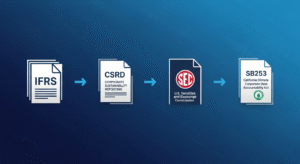





California’s SB 253 was supposed to be the exception. Then the SEC abandoned its federal climate disclosure rule on March 27, 2025 (SEC.gov). That decision created a regulatory vacuum, and state legislatures noticed.
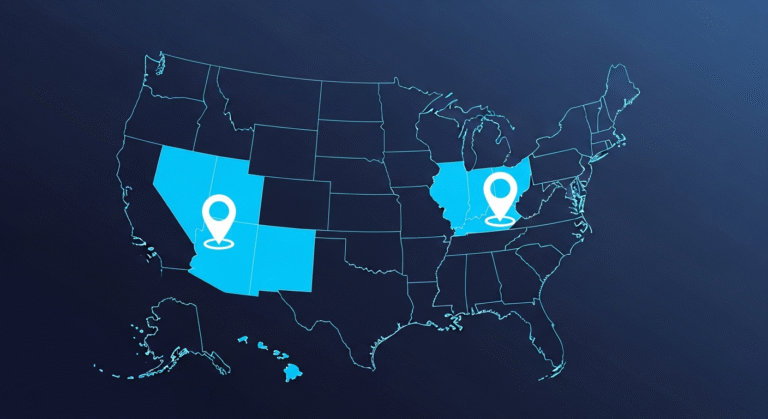
Now at least three additional states have introduced their own versions of SB 253. New Jersey filed S4117. Illinois introduced HB 3673. New York put forward S3456. Each bill mirrors California’s Climate Corporate Data Accountability Act in name, structure, and ambition. This isn’t a coincidence. It’s a coordinated legislative trend.
This tracker breaks down what’s in each bill, how they compare, and what multi-state companies should do right now. Whether you’re already preparing for SB 253 or just hearing about these bills for the first time, the message is the same: state-level climate disclosure is expanding fast.
- At least 3 states (NJ, IL, NY) have introduced SB 253-style climate disclosure bills since the SEC abandoned its federal rule.
- All three bills require Scope 1, 2, and 3 emissions reporting for large companies.
- Companies already preparing for California’s SB 253 can use the same data foundation across jurisdictions.
- Scope 3 emissions account for 70-90% of total corporate footprints (CDP), making supply chain data the biggest challenge.
Source: NJ Legislature, IL General Assembly, NY Senate, CA Legislature. As of April 2026.
California Started It. Other States Are Following.
California’s SB 253 applies to ~4,160 entities on CARB’s preliminary list across both SB 253 and SB 261 doing business in the state, with penalties up to $500,000 for noncompliance (Harvard Law School Forum on Corporate Governance, 2023). That law set a powerful precedent. When the SEC walked away from federal climate rules, states saw an open lane.
SB 253 requires companies earning over $1 billion in annual revenue to report Scope 1, 2, and 3 greenhouse gas emissions. The first reporting deadline arrives in August 2026, with initial reports covering 2025 data. California’s Air Resources Board (CARB) oversees implementation.
The bill survived legal challenges and industry pushback. That survival mattered. It proved a state could enforce corporate climate disclosure without federal backing. Legislators in New Jersey, Illinois, and New York took note.
Within six months of the SEC’s March 2025 withdrawal, all three copycat bills had been formally introduced. The timing wasn’t accidental. For companies evaluating compliance tools, our SB 253 and SB 261 reporting solutions comparison covers 8 platforms in detail.
What Is New Jersey S4117?
New Jersey Senate Bill S4117, the Climate Corporate Data Accountability Act, mirrors California’s SB 253 in structure and scope. Introduced in the NJ Senate, it targets large companies operating in the state and requires greenhouse gas emissions reporting across all three scopes (NJ Legislature).
Key Provisions
S4117 requires covered entities to disclose Scope 1, 2, and 3 emissions annually. Like California’s law, it sets a revenue threshold to determine which companies fall under the mandate. The bill designates a state agency to receive and verify disclosures, and it includes financial penalties for noncompliance.
New Jersey has long positioned itself as a climate leader on the East Coast. The state already participates in the Regional Greenhouse Gas Initiative (RGGI) and has aggressive clean energy targets. S4117 fits that trajectory.
Current Status and Key Differences
As of April 2026, S4117 is in early committee review. It hasn’t yet received a floor vote. The bill’s exact revenue threshold and penalty structure may shift during markup. One notable difference from California: New Jersey’s version may assign enforcement to the Department of Environmental Protection rather than an air resources board.
Why does that matter? Enforcement agency expertise shapes how strictly a law gets implemented. Different agencies bring different priorities and resources to the table.
What Does Illinois HB 3673 Require?
Illinois House Bill 3673, also titled the Climate Corporate Data Accountability Act, was introduced in the IL House and follows the same blueprint as California’s SB 253. The bill targets large corporations doing business in Illinois and mandates emissions disclosure across all three scopes (Illinois General Assembly).
Key Provisions
HB 3673 requires annual reporting of Scope 1 (direct), Scope 2 (purchased energy), and Scope 3 (value chain) emissions. Scope 3 is the hardest piece. According to CDP, Scope 3 accounts for 70-90% of total corporate emissions (CDP). That’s where the real compliance burden lives.
The bill includes provisions for third-party assurance of reported data. It also establishes penalties for late or inaccurate filings, though specific dollar amounts may change during the legislative process.
Status and Notable Differences
HB 3673 remains in committee in the Illinois House as of April 2026. It hasn’t advanced to a floor vote. Illinois faces a different political landscape than California, so passage isn’t guaranteed. But the bill’s introduction signals growing bipartisan recognition that climate data transparency serves economic interests.
One difference worth watching: Illinois may set a lower revenue threshold than California’s $1 billion mark. That would bring more mid-market companies into scope. We’ve found that threshold decisions often change significantly during committee negotiations.
The identical naming convention across CA, NJ, and IL bills, all called the “Climate Corporate Data Accountability Act,” suggests coordinated drafting, likely supported by the same advocacy networks and model legislation templates.
Sources: CA Legislature, SEC.gov, NJ Legislature, IL General Assembly, NY Senate.
Where Does New York Senate Bill S3456 Stand?
New York introduced Senate Bill S3456 as its own entry into the state-level climate disclosure movement. The bill appeared in Ahrefs SERP data at position 4 for “climate corporate data accountability act,” reflecting growing public and investor interest in state-led approaches (NY Senate).
Overview of Provisions
S3456 targets large companies operating in New York and requires greenhouse gas emissions disclosure. Like its counterparts in NJ and IL, the bill draws heavily from California’s framework. New York’s version includes requirements for emissions reporting, climate-related financial risk disclosure, and third-party verification.
New York brings unique weight to this trend. It’s home to Wall Street. The state’s financial regulators already pay close attention to climate risk through the New York Department of Financial Services (DFS). A state-level disclosure mandate from New York would carry outsized influence on capital markets.
Current Status
S3456 is in the early stages of the legislative process. As with the NJ and IL bills, specific provisions may evolve as the bill moves through committees. New York has a track record of ambitious environmental legislation, but the state also faces political complexity that can slow progress.
How Do These Bills Compare?
At least four states now have active or enacted climate disclosure legislation. By most estimates, over 50,000 companies globally already face some form of climate disclosure mandate. The table below shows how the US state-level bills stack up against each other.
Sources: CA Legislature, NJ Legislature, IL General Assembly, NY Senate. Data as of April 2026.
Why Are States Acting Now?
The SEC abandoned its climate disclosure rule on March 27, 2025, removing the prospect of a unified federal standard (SEC.gov, 2025). That single decision triggered a cascade of state-level action. But the SEC vacuum is only one of several drivers.
The SEC Vacuum
Without a federal rule, companies face a patchwork of state requirements instead of one national standard. Ironically, this is the outcome many industry groups lobbied against. The absence of federal leadership made state action more likely, not less.
Growing Investor Pressure
Institutional investors want climate data. They’ve been asking for it through shareholder proposals, engagement campaigns, and portfolio screening. When the SEC couldn’t deliver mandatory disclosure, investors turned to state legislatures as an alternative path.
State Attorney General Litigation
State attorneys general have filed climate-related lawsuits against fossil fuel companies and other large emitters. These cases need data. Mandatory disclosure laws give AGs a stronger foundation for enforcement and litigation strategies.
California Proved It Works
SB 253 survived court challenges. Companies started preparing. The sky didn’t fall. California demonstrated that state-level climate disclosure is legally viable and practically implementable. That proof of concept matters enormously for other legislatures weighing similar bills.
The SEC abandoned its federal climate rule in March 2025, leaving no national standard. States moved in to fill the gap.
Institutional investors want comparable climate data. Shareholder proposals and engagement campaigns pushed legislatures to act.
State attorneys general need emissions data for climate lawsuits. Mandatory disclosure strengthens their enforcement foundation.
SB 253 survived legal challenges and companies began preparing. California proved state-level climate disclosure is viable.
Source: SEC.gov, Harvard Law School Forum, CDP, state legislative records.
What Does This Mean for Multi-State Companies?
Research shows that 83% of companies report difficulty accessing reliable emissions data across their value chains (TCFD Status Report, cited in WRI/GHG Protocol analysis). Multi-state companies face that challenge multiplied. But there’s good news: the copycat structure of these bills means one data foundation can serve all four jurisdictions.
The Overlap Advantage
If you’re already preparing for SB 253, you’re largely prepared for the NJ, IL, and NY bills. The core requirement is the same: Scope 1, 2, and 3 emissions data, verified by a third party, reported annually. Your emissions inventory doesn’t change just because another state wants to see it.
Watch for State-Specific Nuances
That said, don’t assume perfect uniformity. Revenue thresholds may differ. Reporting timelines won’t align perfectly. Enforcement agencies vary by state, and each agency interprets rules slightly differently. Companies should track these nuances without overbuilding separate compliance programs for each jurisdiction.
The smart approach? Build one robust emissions data system. Then add thin compliance layers for state-specific formatting, deadlines, and submission requirements.
How Can Companies Stay Ahead of State Climate Disclosure Laws?
By most estimates, over 50,000 companies worldwide already operate under some form of climate disclosure mandate. US companies are catching up fast. The companies that prepare now will spend less, stress less, and perform better when deadlines arrive.
Monitor Legislation Actively
Don’t rely on annual regulatory reviews. State bills can advance quickly. Set up alerts for NJ S4117, IL HB 3673, NY S3456, and any new bills introduced in other states. Legislative tracking tools and ESG-focused law firms can help.
Build Flexible Reporting Infrastructure
Your emissions data system should handle multiple reporting formats and jurisdictional requirements. Rigid, single-framework tools will create headaches as more states introduce disclosure laws. Flexibility matters more than ever.
Don’t Wait for Final Rules
California’s SB 253 reporting begins in August 2026. That deadline is real. Companies that wait for every state bill to finalize before acting will find themselves scrambling. Start collecting Scope 1, 2, and 3 data now. The core requirements won’t change significantly across jurisdictions.
Use a Platform That Supports Multiple Jurisdictions
Manual spreadsheet-based compliance breaks down at scale. Companies operating across California, New Jersey, Illinois, and New York need a centralized platform that maps data to multiple frameworks simultaneously.
How Credibl ESG Helps
Credibl ESG is built for exactly this kind of multi-jurisdiction complexity. The platform supports multiple disclosure frameworks, including California SB 253, CSRD, ISSB, and emerging US state requirements. Companies can manage Scope 1, 2, and 3 data in one place, generate reports aligned to different regulatory formats, and track compliance deadlines across jurisdictions. As state-level climate disclosure laws expand, Credibl ESG’s flexible architecture ensures companies can adapt without rebuilding their reporting infrastructure from scratch.
Frequently Asked Questions
Will other states follow California’s climate disclosure model?
Very likely. New Jersey, Illinois, and New York have already introduced SB 253-style bills. With the SEC’s federal climate rule abandoned in March 2025 (SEC.gov), no federal standard exists to fill the gap. Legislative tracking services suggest additional states may introduce similar measures in 2026-2027, particularly in states with existing climate policy frameworks.
How similar are NJ S4117 and IL HB 3673 to California SB 253?
Very similar. Both bills share the same name, the Climate Corporate Data Accountability Act, and mirror SB 253’s structure. They require large companies to disclose Scope 1, 2, and 3 emissions annually. Key differences involve revenue thresholds, enforcement agencies, and implementation timelines. Companies already compliant with SB 253 will find the transition straightforward.
Do I need separate compliance programs for each state’s law?
Not necessarily. Because NJ, IL, and NY bills model California’s framework, a single emissions data foundation can serve all jurisdictions. The core data, Scope 1, 2, and 3 emissions, stays the same. Watch for state-specific nuances in thresholds, deadlines, and submission formats. Build one system, then add thin compliance layers for each state.
When will NJ S4117 and IL HB 3673 likely pass?
Both bills are in early committee stages as of April 2026. California’s SB 253 took roughly two years from introduction to signing. A realistic estimate for NJ and IL passage is 2027-2028 at the earliest, assuming steady legislative momentum. Companies should not wait for passage to begin preparing, given California’s August 2026 deadline.
Does federal law preempt state climate disclosure laws?
Currently, no. The SEC abandoned its federal climate disclosure rule on March 27, 2025, leaving no federal standard in place. Unless Congress passes a national climate reporting law, states retain full authority to set their own requirements. The legal precedent from California’s SB 253 surviving court challenges further strengthens states’ position.
Conclusion: State Climate Disclosure Is the New Normal
This is a trend, not a blip. California enacted SB 253. The SEC stepped back. New Jersey, Illinois, and New York stepped in. At least four states now have climate disclosure legislation on the books or in the pipeline.
The smartest move for multi-state companies is to prepare once and comply everywhere. Build a strong emissions data foundation that covers Scope 1, 2, and 3. Choose tools that flex across jurisdictions. And don’t wait for every bill to pass before taking action, because California’s August 2026 deadline is already on the calendar.
The question isn’t whether state climate disclosure laws will spread. It’s how quickly your organization will be ready when they do.
Related Reading from Our Climate Disclosure Series
- Best SB 253 and SB 261 Reporting Solutions in 2026 — compare 8 platforms for California climate disclosure compliance.
- SB 253 and SB 261 Lawsuit Tracker — follow the litigation affecting SB 253 and SB 261 enforcement timelines.