





Introduction
Supply chain emissions, or Scope 3 emissions, represent the greenhouse gas (GHG) emissions generated in a company’s value chain, both upstream (suppliers, materials, transport) and downstream (product use, disposal). For many organisations, Scope 3 emissions account for the majority of their climate impact. According to MIT and other sources, indirect emissions along the value chain account for about 75% of a company’s total emissions on average.
Despite this, many companies still struggle to measure and manage these emissions due to data gaps, inconsistent reporting, and a lack of visibility. The rise of regulation (e.g. EU CSRD), stakeholder pressure, and climate risk exposure are driving companies to seek reliable solutions. Climate risk platforms for supply chains have emerged to help organisations track, report, and reduce their Scope 3 emissions more effectively.
What is a Climate Risk Platform?
A climate risk platform is a digital tool or software solution designed to help organisations understand and manage the risks and impacts associated with climate change, especially across their supply chains. Key functionalities often include:
- Emission measurement and accounting, covering Scope 1 (direct), Scope 2 (indirect from purchased energy), and Scope 3 (value-chain).
- Risk assessment, including physical risks (weather events, natural disasters) and transition risks (carbon pricing, regulation, shifts in market demand).
- Scenario modelling to simulate future conditions such as carbon taxes, regulatory changes, or supplier changes.
- Supplier data collection and engagement, often via portals, questionnaires, or integrations.
- Reporting tools aligned with global standards, frameworks, and compliance obligations.
Find out more about the Top 9 Climate risk reporting platforms – learn more.
Why Managing Supply Chain Emissions is Necessary?
- Dominant share of emissions: Scope 3 emissions are often many times larger than operational (Scope 1 & 2) emissions. For instance, one CDP/BCG study found that upstream Scope 3 emissions are on average 26 times higher than operational emissions in many sectors.
- Regulatory trends are tightening disclosure requirements (e.g., CSRD in the EU), meaning businesses must show credible Scope 3 measurement and plans.
- Financial and reputational risk: Companies with opaque supply chains are more exposed to climate liabilities, shifting tariffs, carbon taxes, and investor scrutiny.
- Opportunity for improvement: By targeting Scope 3, companies can uncover emissions hotspots, improve efficiency, reduce costs (e.g. logistics, materials), and strengthen supplier relationships.
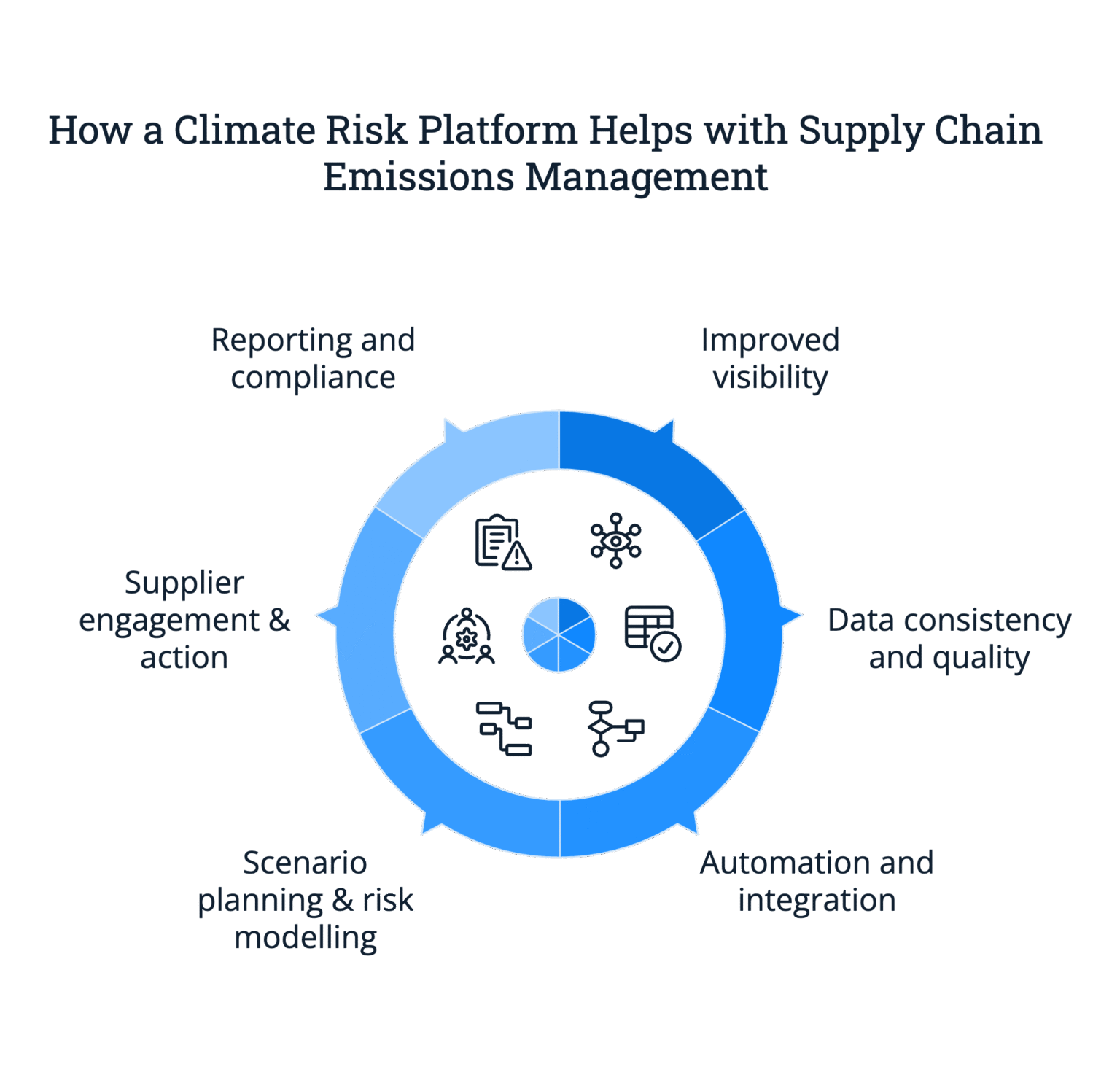
How a Climate Risk Platform Helps with Supply Chain Emissions Management?
- Improved visibility: You gain insights into which suppliers, regions, or processes contribute most to emissions, allowing better prioritisation.
- Data consistency and quality: Platforms standardise emission factor usage, method, and data inputs; many allow for gap-filling where supplier data is missing.
- Automation and integration: Integration with procurement, ERP, logistics, and supplier systems reduces manual work and improves timeliness.
- Scenario planning & risk modelling: Ability to test “what if” situations—carbon price shocks, regulation changes, supplier shifts—to inform strategic decisions.
- Supplier engagement & action: Platforms often have tools to gather data, score suppliers, share improvement plans, and track progress.
- Reporting and compliance: Helps produce reports aligned with established frameworks (GHG Protocol, TCFD, CSRD, CDP), easing disclosure burdens and external audits.
Top 8 Climate Risk Platforms
Below are eight platforms (excluding Watershed, Greenly, Sweep, Persefoni, and Workiva) that are strong for supply chain emissions tracking and climate risk management. Each overview is concise and focuses on strategic strengths. I’ve also included links to their websites where available.
- Credibl ESG
Credibl offers an AI-powered ESG and climate risk platform that combines full Scope 1, 2, and 3 emissions tracking with supplier engagement and product-level foot printing. It integrates physical & transition risk modelling (mapping supplier locations, regulatory exposure, future carbon costs). It automates emission factor matching and gap-filling for better data reliability. Dashboards help sustainability leads identify high-emission suppliers and run scenario analyses. Ideal if you want both emissions data and climate risk in one tool.
Credibl’s platform offers end-to-end Scope 1, 2, and 3 carbon accounting, including tools for supplier engagement and product-level footprint tracking. By digitizing the supply chain “from farm to finished product,” Credibl helps companies achieve a new level of supply chain transparency
- IBM Envizi
IBM Envizi is built for enterprise-scale emissions tracking, analytics, and reporting across complex global operations and supply chains. It can pull in data from utilities, procurement, transportation, and suppliers. Offers benchmarking against industry peers, anomaly detection, and compliance-aligned reporting (GHG Protocol, etc.). Especially suitable for large organisations seeking deep supply chain visibility and operational integration.
- Microsoft Sustainability Manager
Part of Microsoft’s cloud and data ecosystem, this tool centralises emissions data (Scopes 1-3) using Power BI, Azure, and Dynamics 365 integrations. It aids in collecting supplier data, automating updates, and enabling scenario modelling (carbon cost, regulatory shifts, supplier changes). Works well for firms already invested in the Microsoft stack, enabling the embedding of emissions metrics in procurement and operations workflows. Microsoft’s solution simplifies Scope 3 data collection by using automation (and even AI assistants like Microsoft’s Copilot) to engage suppliers for data and to fill gaps with intelligent estimates.
- Salesforce Net Zero Cloud
Leveraging the Salesforce CRM platform, Net Zero Cloud automates supplier engagement, collects emissions data, and provides dashboards showing emissions by supplier, region, or product. It ties sustainability into the business process (sales, procurement). Strong for organizations that want to make sustainability part of regular operations and stakeholder reporting. Net Zero Cloud may require some customisation for complex accounting needs, but it offers a strong foundation of automation and integration to accelerate supply chain emissions management.
- Ecochain Mobius
Ecochain Mobius is lifecycle assessment (LCA) automation software built for product-level and supplier-tier emission footprints. It empowers manufacturers to measure, improve, and share product footprints without being LCA experts. Offers hotspot identification, scenario comparisons, and integrates with LCA databases. Ideal for product-centric companies or brands wanting transparency and optimization of material and design choices.
- Sinai Technologies
Sinai focuses on financial modelling of emissions, helping businesses integrate carbon pricing, abatement cost curves, and scenario modelling. Enables sustainability and finance teams to align decisions around supplier choice, regulation, and cost risk. Good for organisations wanting to link emissions reduction with financial risk and performance. Another key feature of Sinai is its robust scenario analysis engine. The software can simulate future policy or market scenarios – such as rising carbon taxes or new regulations – to project how they would affect supply chain costs and risks.
- EcoVadis – Carbon Action Manager
EcoVadis is known for ESG supplier ratings; its Carbon Action Manager adds emissions data collection, supplier scoring, and improvement guidance focused on Scope 3. Helps you prioritize suppliers for action, monitor progress, and integrate emissions into procurement risk. Works well in supply chains with many suppliers and varying sustainability maturity. Through the Carbon Action Manager, procurement and sustainability teams can request standardized carbon reports from suppliers, who input their emissions data into the system. The platform then consolidates this information to give the customer a clear view of their supply chain footprint.
- Diligent ESG
Diligent ESG integrates governance, risk, and emissions tracking across business units and geographies. Supports full Scope 1-3 data, audit-readiness, reporting aligned with global standards, and risk oversight. Strong choice for organizations that treat ESG and supply chain emissions as part of corporate governance and compliance. A notable aspect is the focus on compliance and audit-readiness – Diligent ESG is designed to make it easier to comply with evolving regulations by providing documentation trails and assurance support. Companies can generate reports for regulators or stakeholders with confidence that the data meets disclosure standards.
Conclusion
Selecting a climate risk platform for supply chain emissions management is more than a technical or budget decision—it’s strategic. When evaluating options, sustainability leads should consider:
- The scope & coverage of the platform (full upstream/downstream Scope 3)
- Data quality, supplier engagement, and ability to close gaps over time
- Integration with existing systems (procurement, ERP, operations, finance) to reduce manual work
- Capability for scenario & risk modelling (transition risk, carbon pricing, regulatory change)
- Reporting & compliance, and audit readiness with global frameworks and emerging regulations
- Ease of use, scalability, and supplier network maturity
Among the platforms listed, Credibl stands out for offering a comprehensive blend: emissions tracking, risk analysis, supplier engagement, and robust reporting, all in one tool. If you aim to build visibility and resilience in your supply chain, Credibl can help you get there faster.
FAQs
Q1: Which are the biggest sources of Scope 3 emissions that platforms typically help manage?
Most Scope 3 emissions come from purchased goods and services, upstream transportation & distribution, and the use and end-of-life of sold products. Platforms often emphasise these because they are large in magnitude and offer opportunities for reductions. Suppliers, material choices, logistics, and product design are key levers.
Q2: Can a company get reliable data from suppliers who are not mature in sustainability reporting?
Yes, but it takes effort. Good platforms offer supplier portals or surveys to collect primary data. Where suppliers can’t provide data, they often allow the use of emission factor databases or spend-based estimates, clearly flagging the associated uncertainty. Over time, you can move to more precise data via supplier training or incentives.
Q3: What kind of return on investment (ROI) might a company expect from implementing a climate risk platform?
ROI comes in both tangible and intangible forms. Tangible savings could include reduced material or logistics costs, avoidance of carbon pricing or penalties, and improved efficiency. Intangible benefits include risk mitigation, improved stakeholder trust, better access to capital, and regulatory compliance. Early hotspot insights often lead to quicker action that yields both cost and emissions reductions.
Q4: How does regulation affect which platform features are most critical?
Regulation (like mandatory disclosures, carbon border taxes, or climate risk reporting requirements) makes certain features more important—such as audit trails, scenario modelling, alignment with standards (CSRD, GHG Protocol, TCFD), and transparency in supplier data. If your jurisdiction or market is tightening such rules, pick a platform that anticipates these needs.
Q5: How long does it usually take from selecting a platform to seeing material improvements in supply chain emissions?
It depends on your supply chain complexity and data maturity. Some companies see improvements in hotspots, reporting, or supplier engagement within 3-6 months. Full Scope 3 coverage and consistent reductions often take 9-18 months or more, depending on scale and effort.