






Introduction
For years, the sustainability audit process has been a labour-intensive exercise in data archaeology. Companies relied heavily on manual data collection, pulling numbers from spreadsheets, emails, and disparate systems. Deloitte’s 2024 Sustainability Action Report discusses the challenges companies face with ESG data quality. It highlights that “more than half (57%) cite data quality as the top challenge” and mentions how organizations are investing in sustainability reporting to gain benefits like “greater efficiencies” and “lower risk.”
Data often exists in silos, with different departments—from operations and HR to finance and procurement—tracking metrics in their unique ways. This lack of a single, unified source of truth makes it incredibly difficult to reconcile data, leading to inconsistencies and gaps that auditors are quick to flag.
The time and resources consumed by this manual data wrangling can be immense, delaying reporting cycles and diverting skilled professionals from more strategic tasks. Most critically, the lack of a clear, traceable data lineage makes it challenging to provide auditors with the verifiable evidence they need, turning the entire process into a stressful and often reactive event.
The AI and Automation Solution: A Paradigm Shift
AI and automation represent a fundamental shift in how businesses approach sustainability data. These technologies are not about replacing human insight but about empowering it. Gartner has published numerous reports and articles on the impact of AI on supply chains. A 2024 article discusses how AI, ESG regulations, and geopolitics are the top influences on supply chain success. (Gartner)
- Empowering Human Insight: By automating repetitive and tedious tasks, AI liberates sustainability and audit professionals to focus on analysis, strategy, and risk management.
- Key Benefits: This new paradigm introduces unprecedented:
- Efficiency: Streamlining processes and reducing manual effort.
- Accuracy: Minimizing human error through automated validation.
- Scalability: Handling vast amounts of data without proportional increases in human resources.
- Transparency: Providing clear, auditable trails for all data.
- Enabling, Not Replacing: AI acts as a sophisticated data manager, capable of ingesting, processing, and analyzing vast amounts of information in a fraction of the time it would take a human team. The result is a more robust, reliable, and transparent system that ensures data is not only collected but also prepared to a level of quality that stands up to the most rigorous audits.
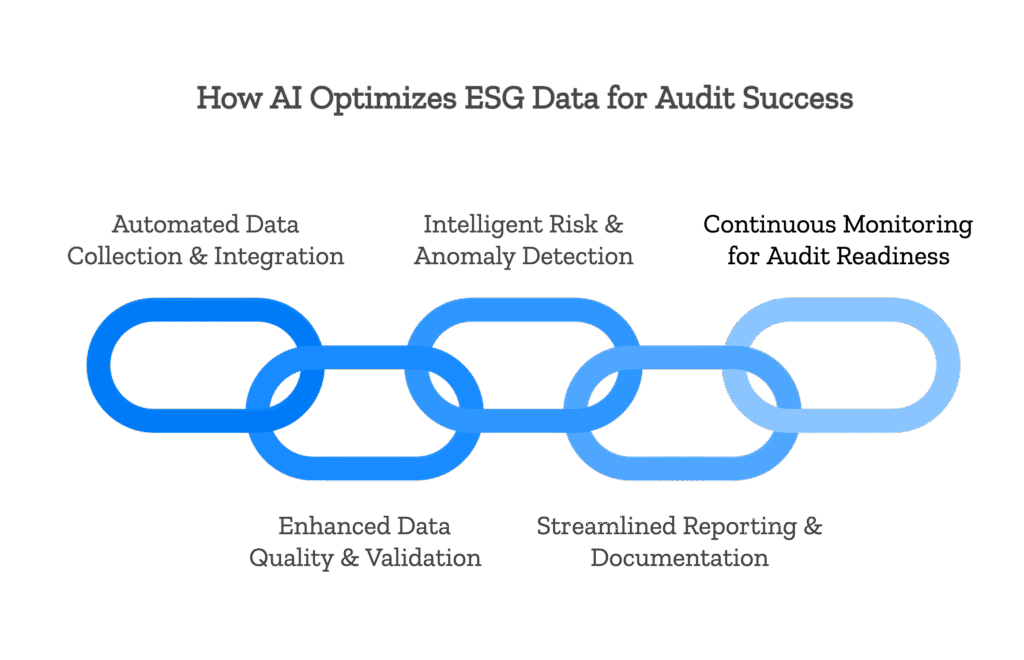
How AI Optimizes ESG Data for Audit Success
AI’s role in the sustainability audit lifecycle is multifaceted, addressing the core pain points of traditional methods with intelligent solutions.
- Automated Data Collection and Integration:
- AI-powered platforms can connect directly to a company’s diverse data sources, from IoT sensors on a factory floor to ERP systems, utility meters, and even supplier databases.
- Through APIs and robotic process automation (RPA), data is automatically pulled in real-time, eliminating manual entry and the associated human error.
- This creates a continuous, dynamic flow of information that is always up-to-date and ready for analysis.
- Enhanced Data Quality and Validation:
- One of the most significant advantages of AI is its ability to ensure data integrity.
- Machine learning algorithms can automatically flag incomplete, inconsistent, or anomalous data points. For instance, a sudden, unexplained spike in water consumption data would be immediately identified, prompting a human expert to investigate.
- This proactive data validation ensures that the information used for reporting is reliable and accurate, providing a “single source of truth” that is essential for audit success.
- Intelligent Risk and Anomaly Detection:
- Beyond simple data validation, AI can perform sophisticated risk analysis.
- By analyzing historical data and industry benchmarks, it can identify emerging risks or trends that might otherwise go unnoticed.
- For example, an AI model could predict a potential increase in compliance risk for a specific product line based on changing regulations or supplier performance. This predictive capability allows companies to proactively address issues before they become material audit findings.
- Streamlined Reporting and Documentation:
- AI-powered platforms like Credibl can automatically generate reports and documentation that align with major frameworks like GRI, SASB, and the new CSRD.
- Mention the benefit of having a clear, auditable trail of all data from source to report.
- Continuous Monitoring for Audit Readiness:
- AI constantly monitors data for compliance and accuracy.
- This transforms the audit from a periodic, stressful event to an ongoing, manageable process.
Overcoming Challenges: The Human-in-the-Loop Approach
The implementation of AI is not without its challenges. There are valid concerns about data security, algorithmic bias, and the so-called “black box” problem, where an AI’s decision-making process is not transparent. These challenges underscore the importance of a “human-in-the-loop” approach.
- AI as a Tool, Not a Replacement: AI is a powerful tool, but it is not a replacement for human expertise and judgment.
- The Crucial Role of Humans: Sustainability professionals and auditors are essential for:
- Interpreting complex social and governance issues.
- Providing strategic context and nuanced insights.
- Ensuring the ethical use of technology and addressing potential biases.
- A Symbiotic Relationship: The best-case scenario involves a symbiotic relationship where AI performs the heavy lifting of data preparation and analysis, and human experts provide critical oversight, interpretation, and strategic decision-making.
The Future of ESG Audits: Where We’re Heading
The trajectory is clear: the future of ESG audits is intelligent, automated, and continuous.
- Shift to Proactive Auditing: We are moving from a reactive, compliance-focused mindset to a proactive, strategy-driven one.
- Standardization of AI Platforms: In the coming years, AI-powered platforms will likely become the standard for ESG reporting, driven by:
- Increasing regulatory pressure (e.g., CSRD, SEC climate disclosure rules).
- Growing investor demand for verifiable ESG data.
- The inherent efficiencies and accuracy benefits.
- Focus on Impact, Not Just Compliance: This widespread adoption will allow companies to not only meet their reporting obligations with ease but also to gain deeper, actionable insights that drive real, meaningful change in their sustainability performance.
Conclusion: Embracing a Smarter, More Sustainable Future
The traditional methods of preparing for a sustainability audit are no longer sufficient to meet the demands of today’s complex regulatory and stakeholder landscape. By embracing AI and automation, companies can transform their ESG data preparation from a manual, error-prone burden into an efficient, accurate, and transparent process.
This shift not only ensures a more successful audit outcome but also provides a robust foundation for genuine, long-term sustainability. It is a journey toward a smarter, more accountable, and ultimately more sustainable business world.
Ready to streamline your ESG audits? Explore Credibl’s AI-powered ESG reporting platform to automate data collection, ensure compliance, and enhance transparency. Start your journey towards efficient and effective ESG audits today.
FAQs: Your Questions Answered
Q1: Is AI-powered ESG data collection expensive for small and medium-sized businesses (SMBs)? A: While initial setup can be an investment, many SaaS platforms offer scalable, subscription-based models that are affordable for SMBs. The cost savings from reduced manual labor and more efficient audits often provide a significant return on investment in the long run.
Q2: How do I know the data collected by an AI is secure? A: Reputable AI and automation platforms for ESG data utilize robust security measures, including data encryption, access controls, and compliance with privacy regulations like GDPR. It’s crucial to vet vendors and ensure their security protocols align with your company’s standards.
Q3: Can AI audit social and governance data, or is it only for environmental metrics? A: AI is highly effective for both. While environmental data is often quantitative and straightforward, AI, particularly with the use of Natural Language Processing (NLP), can analyze unstructured social and governance data from employee surveys, news articles, and policy documents to identify trends and risks.
Q4: Will AI reduce the need for human auditors? A: No, AI will change the role of human auditors. Instead of spending time on tedious data gathering and verification, auditors can focus on higher-value tasks, such as strategic analysis, interpreting complex findings, and providing expert advice. It elevates the auditor’s role from a data collector to a strategic consultant.