






Introduction
Nowadays, sustainability reporting is no longer just a voluntary effort; it’s an essential part of doing business for any company aiming for long-term success. Investors, regulators, and customers are no longer content with broad promises; they expect clear, audit-ready data on carbon emissions and genuine transparency.
Recent research underscores the importance of this: the 2023 CDP Global Climate Change Report reveals that companies with robust, reliable emissions tracking are 40% more likely to secure ESG-focused investment, providing these businesses a significant advantage in attracting funding.
Getting Scope 1, 2, and 3 emissions right isn’t only about compliance. Accurate, verifiable reporting lets companies show their leadership on sustainability, improve their operational oversight, and win the trust of stakeholders. In this new era, being audit-ready with emissions data sets leads businesses apart—helping them grow, become more resilient, and build a reputation for real responsibility and forward-thinking action.
Understanding Scope 1, 2, and 3 Emissions
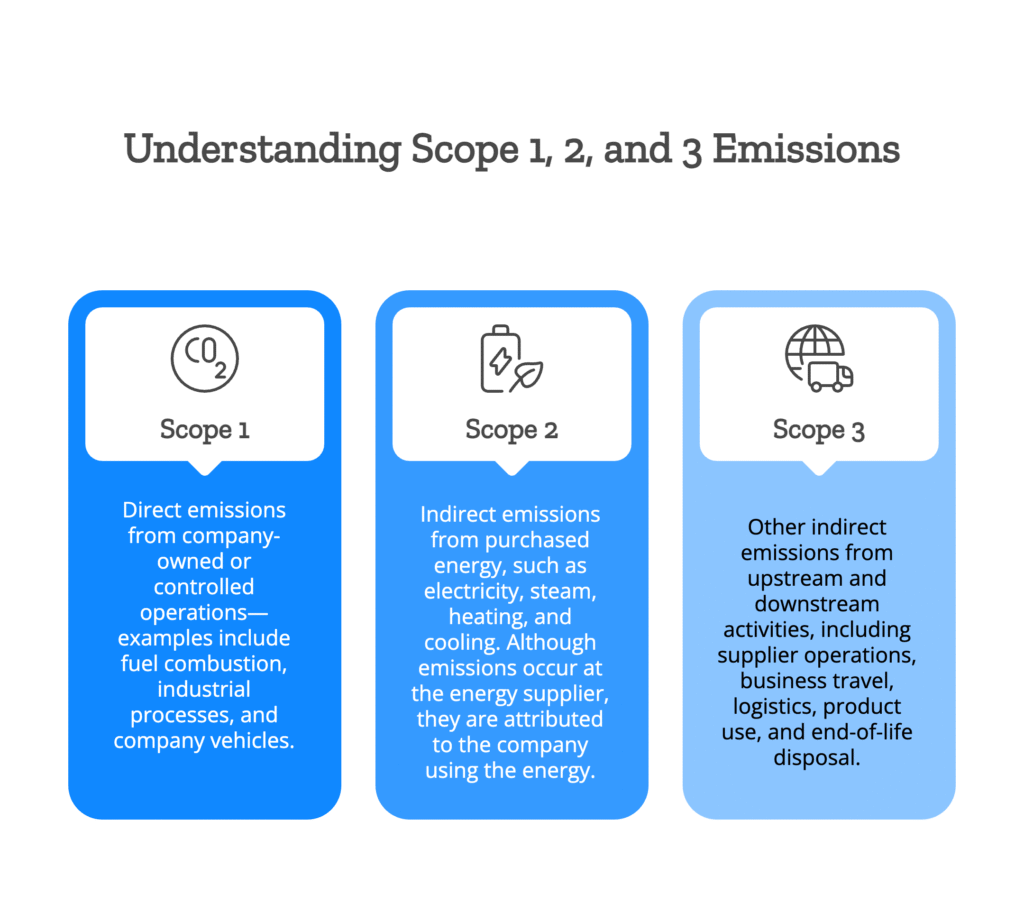
Companies must first clearly define what each scope covers to measure accurately:
- Scope 1: Direct emissions from company-owned or controlled operations—examples include fuel combustion, industrial processes, and company vehicles.
- Scope 2: Indirect emissions from purchased energy, such as electricity, steam, heating, and cooling. Although emissions occur at the energy supplier, they are attributed to the company using the energy.
- Scope 3: Other indirect emissions from upstream and downstream activities, including supplier operations, business travel, logistics, product use, and end-of-life disposal. Ignoring Scope 3 can significantly understate a company’s environmental impact, risking both compliance and reputation.
Why Accurate Tracking and Verification Matter
Accurate emissions tracking is critical for:
- Regulatory Compliance: Frameworks like CSRD (EU) and BRSR (India) mandate verified emissions reporting. Non-compliance can result in fines, legal consequences, or reputational damage.
- Audit Readiness: PwC’s 2023 ESG survey reveals that 68% of companies experience delays in audit reporting due to Scope 3 data gaps. Accurate tracking ensures smoother audits and reduces the risk of findings.
- Stakeholder Confidence: Transparent, verified data builds trust with investors, regulators, and partners. ESG-focused investors are 40% more likely to invest in companies with robust emissions reporting.
- Operational Insights: Understanding emissions helps identify inefficiencies, reduce energy costs, and optimize supply chains.
Furthermore, Deloitte’s 2023 ESG survey found that companies with high-quality emissions data report 30% faster decision-making in sustainability initiatives.
Best Practices to Track Scope 1, 2, and 3 Emissions
1. Tracking Scope 1 Emissions
Scope 1 emissions are direct and typically easier to measure. Recommended steps:
- Inventory Emission Sources: Boilers, generators, vehicles, and industrial machinery.
- Fuel Consumption Conversion: Apply IPCC emission factors to convert fuel usage into CO₂e.
- Real-Time Monitoring: IoT-enabled sensors and automated meters reduce manual errors and provide continuous data.
Organizations using automated Scope 1 tracking reduce manual errors by up to 30% (CDP, 2023).
2. Tracking Scope 2 Emissions
Scope 2 emissions involve purchased energy. Key practices:
- Energy Data Collection: Collect meter readings and utility bills across all facilities.
- Emission Factor Selection: Use location-based or market-based emission factors. Market-based factors are preferred for audit compliance (ISO 14064-1:2018).
- Renewable Energy Verification: Track RECs and Guarantees of Origin to validate renewable energy usage.
Companies leveraging market-based factors for the Scope 2 report 15–20% greater audit accuracy compared to location-based methods (GHG Protocol, 2023).
3. Tracking Scope 3 Emissions
Scope 3 emissions are complex due to their indirect nature. Steps to ensure accuracy include:
- Identify High-Impact Suppliers: Focus on suppliers responsible for top 80% of emissions.
- Supplier Engagement: Collect data through digital surveys or automated reporting portals.
- Standardized Emission Factors: Use GHG Protocol, DEFRA, or EPA datasets where direct data is unavailable.
- Spend-Based Estimations: Only when primary data is unavailable; always cross-validate with supplier data.
Want to monitor your emissions in real time? Discover how here.
Tools and Technologies for ESG Data Management
Modern ESG platforms significantly enhance data quality and audit-readiness. Key capabilities include:
- Centralizing emissions data across multiple facilities and geographies.
- Automating calculations for Scope 1, 2, and 3 using standardized emission factors.
- Maintaining audit-ready records with timestamped and verified metadata.
- Providing dashboards for real-time insights, anomaly detection, and reporting.
Credibl’s ESG platform allows companies to automate emissions tracking, integrate supplier data, and generate reports compliant with CSRD, GRI, and BRSR, improving reporting efficiency by up to 50%. Learn more
Overcoming Common Challenges
| Challenge | Scope | Solution |
| Incomplete supplier data | Scope 3 | Supplier engagement portals, automated reminders |
| Manual data entry errors | Scope 1 & 2 | Sensors, automated data ingestion |
| Inconsistent emission factors | All scopes | ISO/ GHG Protocol-compliant factors |
| Multi-departmental data silos | All scopes | Centralized ESG platform with role-based access |
| Lack of real-time monitoring | All scopes | IoT-enabled meters and sensors |
By addressing these challenges proactively, companies can maintain audit-ready emissions data while driving operational and environmental improvements.
Key Insights and Trends in Emissions Tracking
- Shift Toward Real-Time Monitoring: Companies adopting IoT-enabled sensors for Scope 1 and 2 achieve 20–30% faster reporting cycles.
- Supplier Collaboration for Scope 3: Engaging suppliers digitally ensures higher accuracy and reduces audit risk.
- AI-Powered Validation: AI tools detect anomalies, validate data, and generate predictive insights, enabling companies to proactively manage emissions and anticipate audit questions.
- Integrated ESG Platforms: Organizations are moving away from spreadsheets to cloud-based platforms, reducing human errors and improving data traceability.
- Regulatory Alignment: CSRD and SEC rules increasingly require verified Scope 1, 2, and 3 emissions, pushing companies to standardize methodologies and reporting.
- Emissions Data Transparency: Companies publishing verified data in investor reports experience higher trust scores and improved ESG ratings.
According to McKinsey 2023, organizations that automate Scope 1 and 2 reporting reduce operational costs by 10–15% annually, while companies improving Scope 3 accuracy increase stakeholder confidence and brand value.
Conclusion
Accurate tracking and verification of Scope 1, 2, and 3 emissions is essential for audit-ready ESG reporting. Implementing a structured data collection process, engaging suppliers, and leveraging modern ESG platforms such as Credibl ensures:
- Compliance with CSRD, GRI, and BRSR.
- Reduced audit risk and enhanced first-time pass rates.
- Operational efficiencies, insights, and sustainable growth.
Ready to transform your ESG reporting? Explore how Credibl centralizes emissions data, automates calculations, and generates audit-ready reports with confidence. Request a demo today.

FAQs
Q1. What is the difference between Scope 1, 2, and 3 emissions?
Scope 1: Direct emissions from owned operations. Scope 2: Indirect emissions from purchased energy. Scope 3: Other indirect emissions across the value chain.
Q2. How can companies collect Scope 3 emissions data effectively?
By prioritizing high-impact suppliers, using standardized emission factors, engaging suppliers digitally, and validating spend-based estimates.
Q3. Which standards should I follow for emissions tracking?
ISO 14064-1:2018, GHG Protocol, CDP, CSRD, and local regulations like BRSR.
Q4. How can technology help in audit readiness?
ESG platforms automate calculations, centralize data, maintain audit trails, and provide dashboards for anomaly detection and reporting.
Q5. How often should emissions data be verified?
Ideally, companies should perform continuous monitoring for Scope 1 and 2, and annual or bi-annual verification for Scope 3.