




The race to net-zero is no longer a distant vision — it’s a business reality. For companies that design, manufacture, or sell products, Product Carbon Footprint (PCF) measurement has become the cornerstone of credible sustainability strategies.
Yet, achieving accurate, audit-ready product-level carbon data is one of the biggest hurdles sustainability teams face. That’s why Credibl’s PCF software is designed not just for compliance, but to help you turn emissions data into a driver for growth, innovation, and competitive advantage.
What is a Product Carbon Footprint (PCF)?
A Product Carbon Footprint measures the total greenhouse gas (GHG) emissions generated throughout a product’s life cycle. This includes:
- Raw material extraction
- Manufacturing processes
- Packaging
- Transportation and logistics
- Product use phase
- End-of-life disposal or recycling
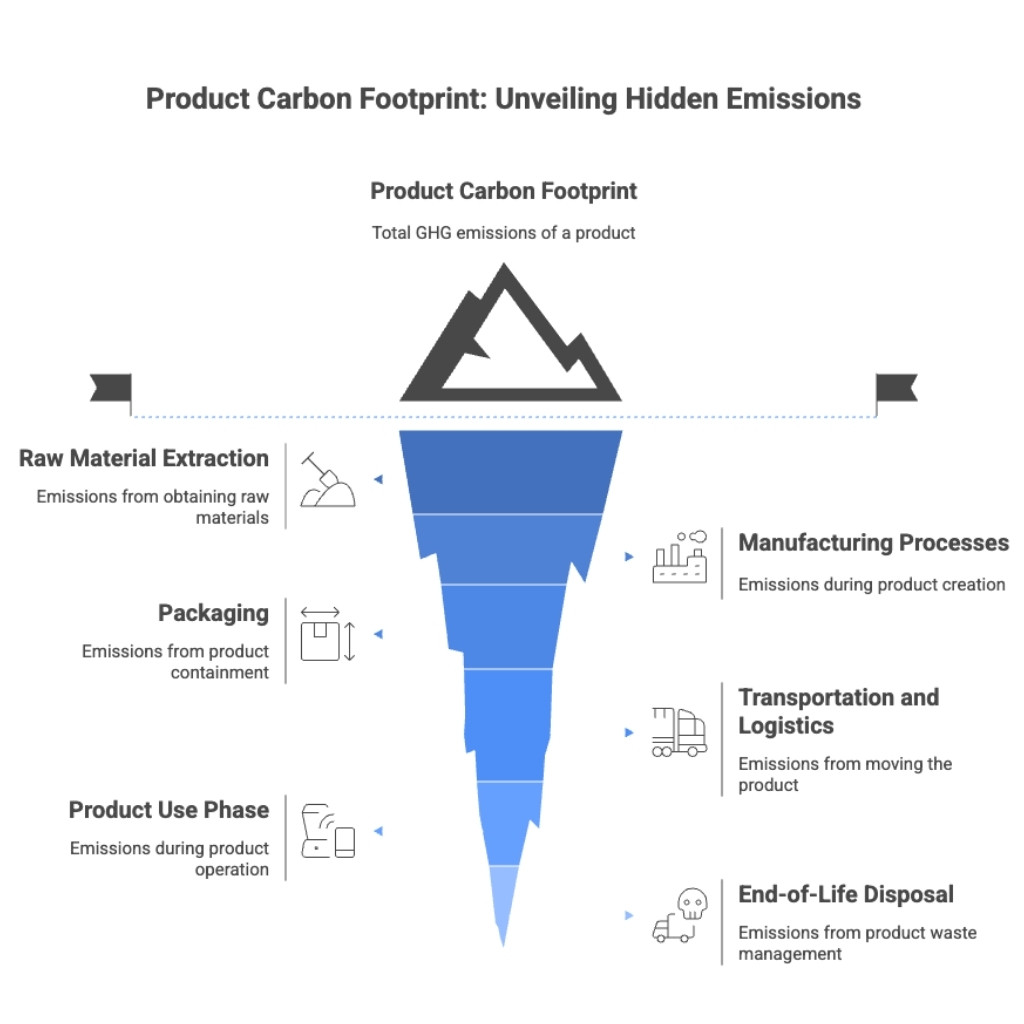
Measured in tCO₂e (tonnes of CO₂ equivalent), PCFs help companies identify high-impact stages, benchmark against industry standards, and design low-carbon alternatives.
Tracking a PCF manually is possible, but slow — this is why many companies now rely on a carbon footprint tracking tool to automate lifecycle calculations and streamline reporting.
Why is Product Carbon Footprint (PCF) Important for companies?
- Meet Demand for Low-Carbon Products
Consumers and B2B buyers now expect verified PCF data and transparent climate reporting. Accurate disclosures help win ESG-linked tenders, build trust, and meet sustainable procurement standards. - Identify and Reduce Emission Hotspots
PCF analysis pinpoints high-impact lifecycle stages—enabling smarter material choices, supplier optimization, efficient production, and lower-carbon packaging and logistics. - Collaborate on Scope 3 Emissions
With Scope 3 making up most corporate emissions, product-level carbon data is now a supplier requirement. Transparent PCF reporting boosts competitiveness, strengthens relationships, and secures long-term contracts. - Gain a Competitive Edge
Low-carbon product portfolios open new markets, cut costs, enhance brand value, and position companies as leaders in sustainability and compliance.
Why Most Companies Struggle with Calculating PCF Without Lifecycle Carbon Accounting Platforms?
- Data Fragmentation: Product-specific energy, material, and waste data often live in multiple ERP systems, spreadsheets, and supplier databases.
- Complex Methodologies: PCF calculations require emission factors, life-cycle assessment expertise, and alignment with global standards (ISO 14067, GHG Protocol Product Standard).
- Manual, Resource-Intensive Processes: Traditional PCF studies can take months, limiting scalability across large product portfolios.
- Lack of Transparency & Audit Readiness: Without automated and standardized workflows, it’s difficult to ensure traceability, audit compliance, and confidence in results.
- Reputational Risk: Incomplete product-level carbon data can lead to greenwashing claims, undermining brand trust and credibility.
Corporate vs. Product Carbon Footprint: Key Differences for Scope 3 Emissions Management
| Aspect | Corporate Carbon Footprint (CCF) | Product Carbon Footprint (PCF) |
| Definition | Measures the total emissions from a company’s operations | Focuses on emissions per product unit or batch |
| Scope Covered | Scope 1 (direct), Scope 2 (purchased energy), and Scope 3 (value chain) | Production-specific energy use, material consumption, packaging, logistics, and sometimes end-of-life |
| Purpose | Understand the organization’s overall climate impact | Identify and manage carbon intensity of individual products |
| Granularity | High-level, organization-wide | Detailed, product-level |
| Use Cases | Corporate reporting, regulatory compliance, overall sustainability strategy | Product design, sourcing decisions, supplier engagement, product differentiation |
| Outcome | “Big picture” view of total emissions | Actionable insights for optimizing design, sourcing, and production |
What Makes Credibl’s PCF Intelligence Hub Stand Out
Credibl’s PCF Intelligence Hub is more than just reporting — it’s a whole lifecycle carbon accounting platform that automates, analyzes, and optimizes carbon data at scale.
Real-Time Data Management and Updates
- Stay informed with live product lifecycle and environmental insights, ensuring data accuracy at every stage.
- Automate data capture from ERPs (SAP), LCA Analysis, production logs, and supplier platforms
- Leverage AI to update emission factors and material-specific impacts continuously.
- Maintain version-controlled, transparent audit trails for every product footprint
Multi-Framework Reporting Compliance
- Align with ISO 14067, GHG Protocol, CSRD, and EU DPP standards
- Generate PCF disclosures with structured data and supporting documentation
- Ensure readiness for third-party verification and investor-grade reporting
Batch-Level Analysis
Gain detailed carbon insights at the production batch level to enhance decision-making and operational efficiency.
- Monitor and compare emissions across batches for trend analysis
- Identify variability in production processes affecting carbon intensity
- Support continuous optimization initiatives with granular batch-level reporting
Hotspot Identification & Optimization
Pinpoint high-emission processes, materials, or activities and drive actionable sustainability improvements.
- Visualize carbon hotspots across the product lifecycle
- Locate optimization opportunities where alternative materials, suppliers, or processes could reduce impact
Our Methodology for Accurate Product Carbon Footprints
Data Collection & Integration
- Gathers operational and supplier data from across the value chain, including upstream activities.
- Captures key inputs such as product details, energy use, effluents and waste, and packaging requirements.
- Automatically ingests production, material, and procurement data from SAP and other enterprise systems, ensuring accurate and up-to-date information.
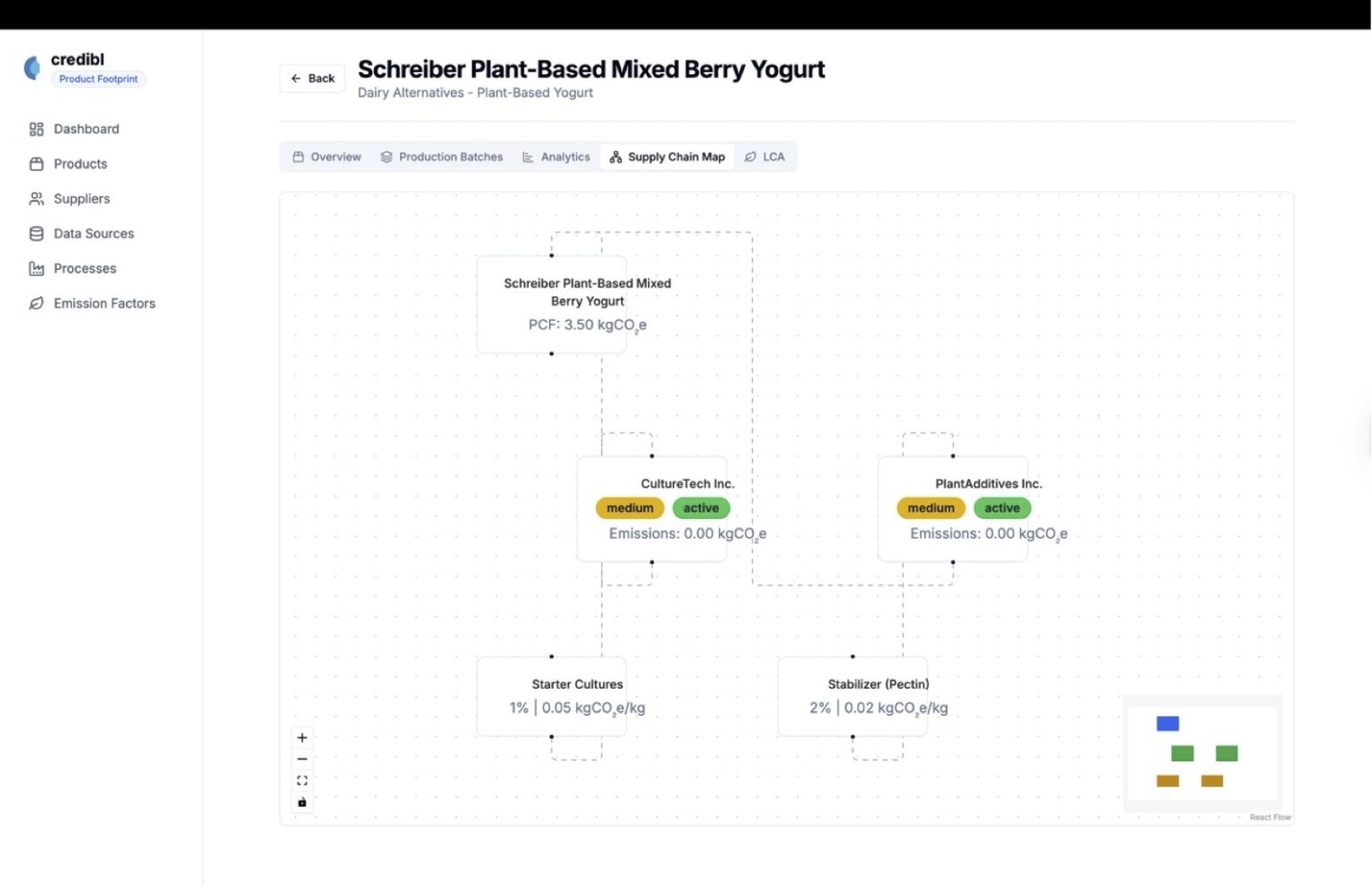
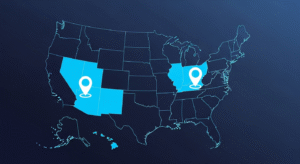
Supply chain map highlighting suppliers who provide primary PCF data and those where secondary emissions databases are used to estimate emission factors.
Lifecycle Carbon Accounting
- Calculates GHG emissions at every stage of the product lifecycle—from raw material acquisition to manufacturing, distribution, use, and end-of-life disposal.
- Supports both cradle-to-gate (up to the point of sale) and cradle-to-grave (entire lifecycle) assessments for maximum flexibility and compliance.
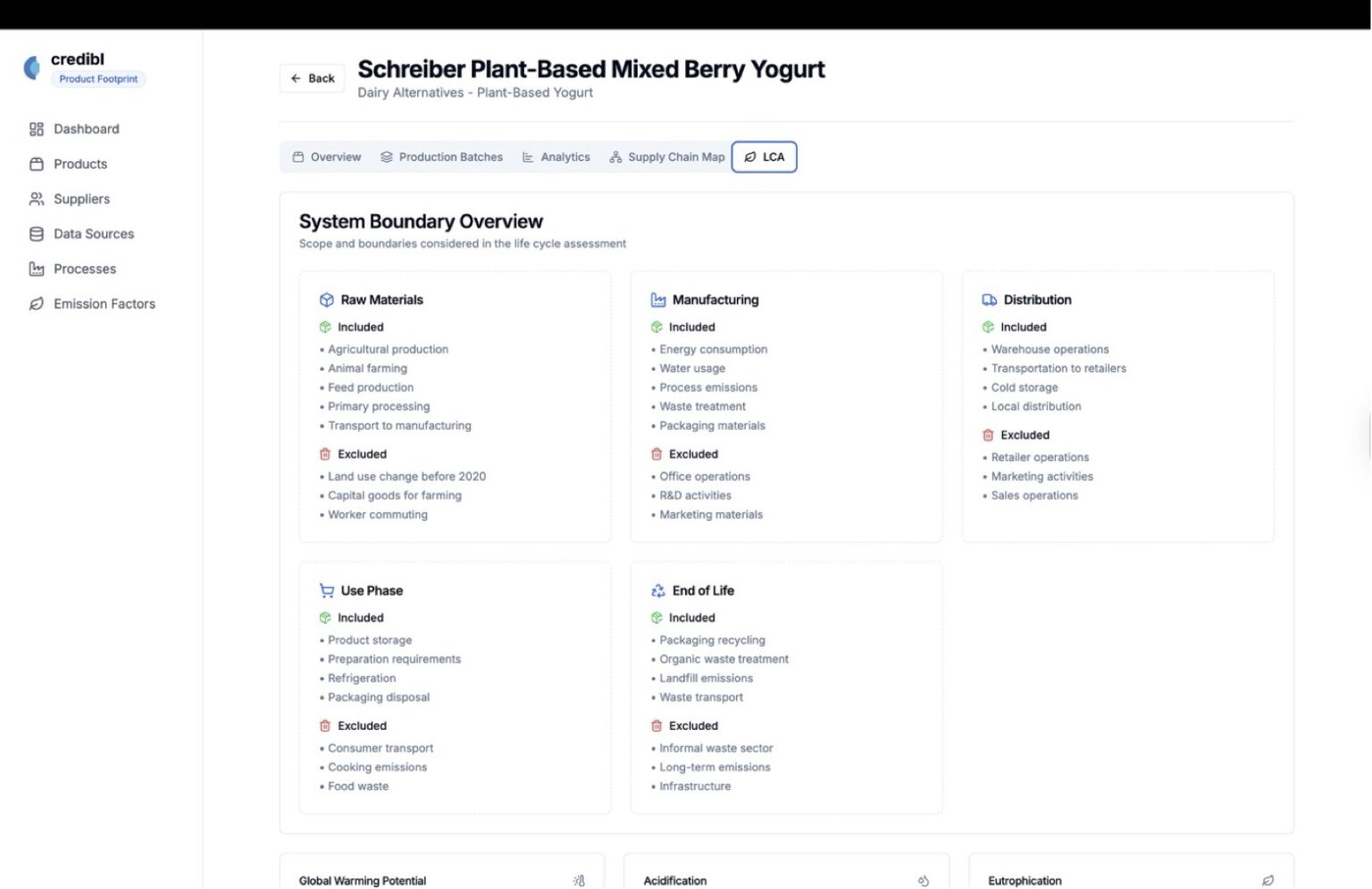
Credibl goes beyond carbon to deliver a complete Life Cycle Assessment (LCA) of your product — mapping environmental impacts from raw material extraction to end-of-life.
Batch-Level Carbon Footprint Analysis
- Calculates GHG emissions at the batch level, enabling comparisons across production runs and supporting scenario planning.
- Provides a breakdown of total emissions for each batch, highlighting contributions from different stages.
- Identifies hotspots such as energy-intensive processes or carbon-heavy materials.
- Surfaces opportunities where procurement optimization or operational changes could reduce impact.
- Supports Scope 3 quantification by integrating supplier data and upstream emissions.
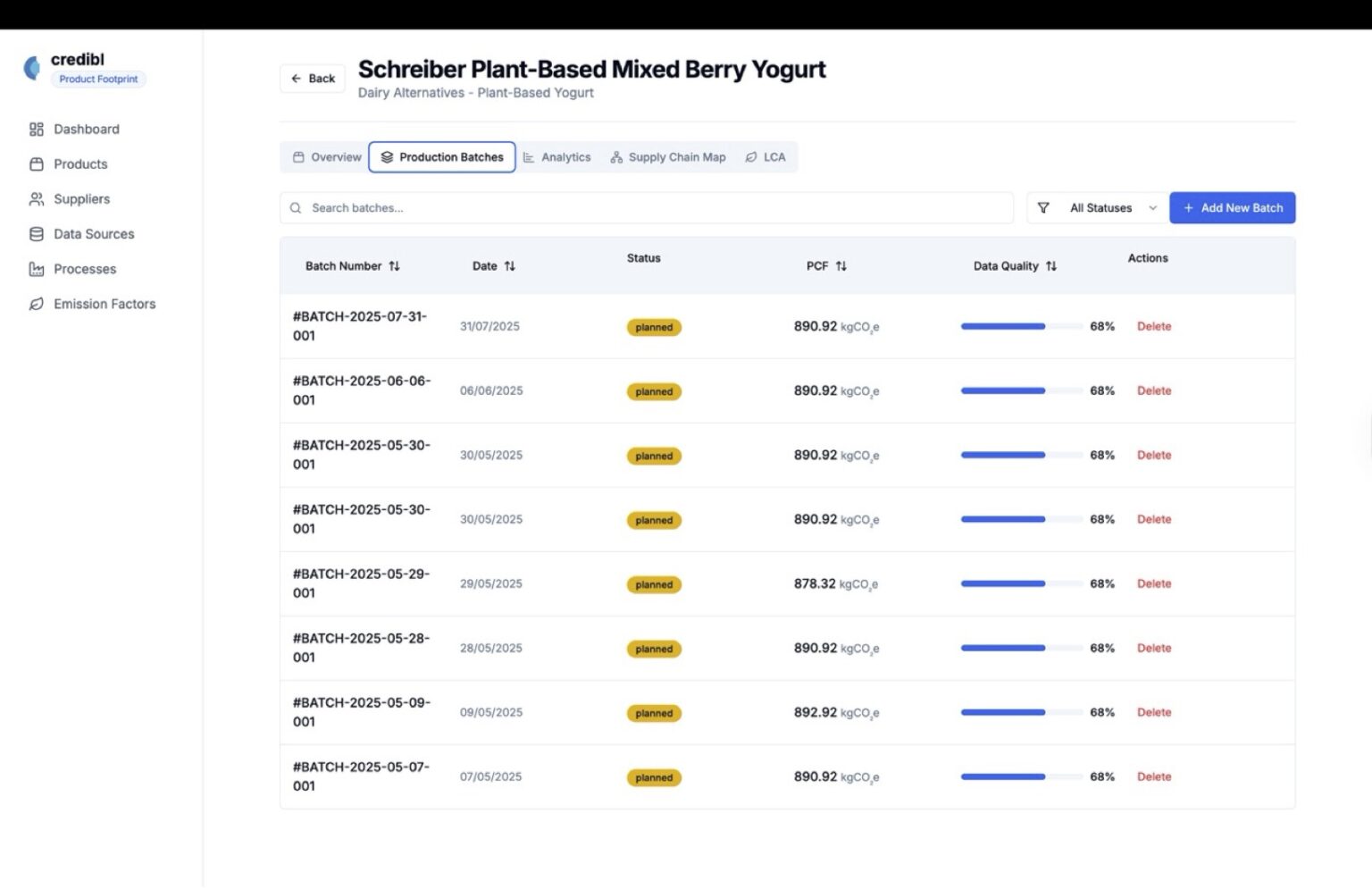
Batch-level PCF calculation – this allows more granularity in PCF calculation as well as makes insights more real-time, linked with on-ground processes.
Product Configuration Overview
- Presents a clear view of each product configuration, including key product details and a breakdown of emissions by contributor category (energy, materials, waste, packaging, etc.).
- Offers a holistic, product-level emissions profile to support transparent reporting and data-driven decision-making.
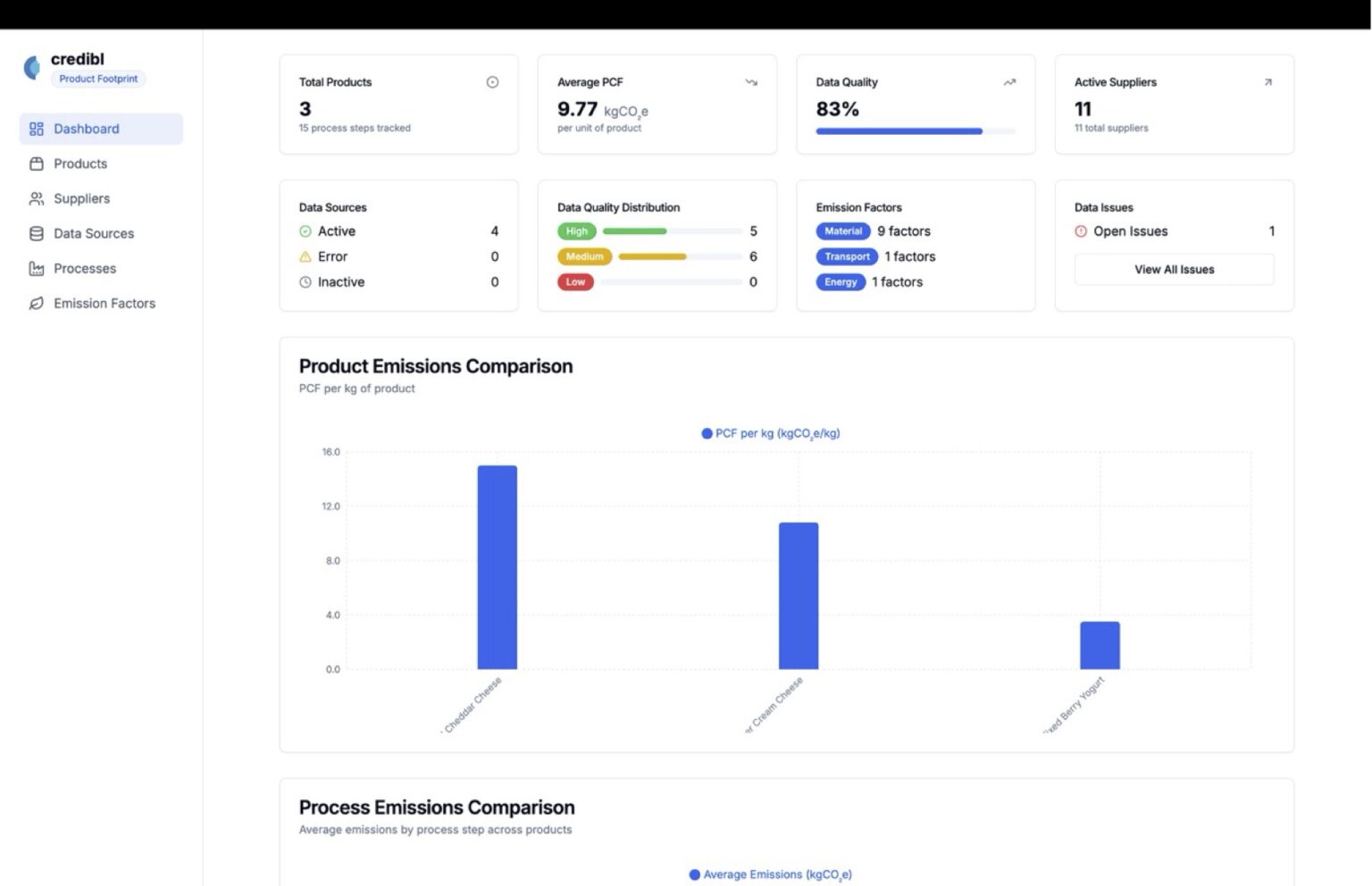
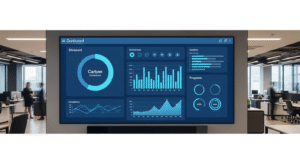
Dashboard showing multiple products and PCF trends across a product portfolio.
Why Choose Credibl for Product Carbon Footprinting?
- End-to-End Visibility
Track emissions across every lifecycle stage and map supply chain impacts for accurate Scope 3 calculations and full product carbon transparency. - Centralized Intelligence
Unify product-level carbon data, update in real time, and pinpoint hotspots to drive targeted emission reduction and operational gains. - Regulatory-Ready
Stay compliant with ISO 14067, CSRD, Digital Product Passport, and other frameworks with standardized, audit-ready outputs. - Low-Carbon Innovation
Leverage emissions data to guide design and production choices, accelerating the shift to low-carbon products and processes. - Scope 3 Control
Integrate supplier-level data for complete value chain accountability and compliance. - Efficiency at Scale
Automate data capture and analytics to cut manual work, reduce errors, and speed up reporting cycles. - Smarter Procurement
Select suppliers based on carbon intensity and cost trade-offs to boost resilience and sustainability. - Market Advantage
Deliver verified low-carbon products and showcase climate leadership to customers and investors.
Future of PCF: What’s Next
By 2030, the way organizations track, manage, and communicate their Product Carbon Footprints (PCFs) will look dramatically different from today. These major shifts are already taking shape:
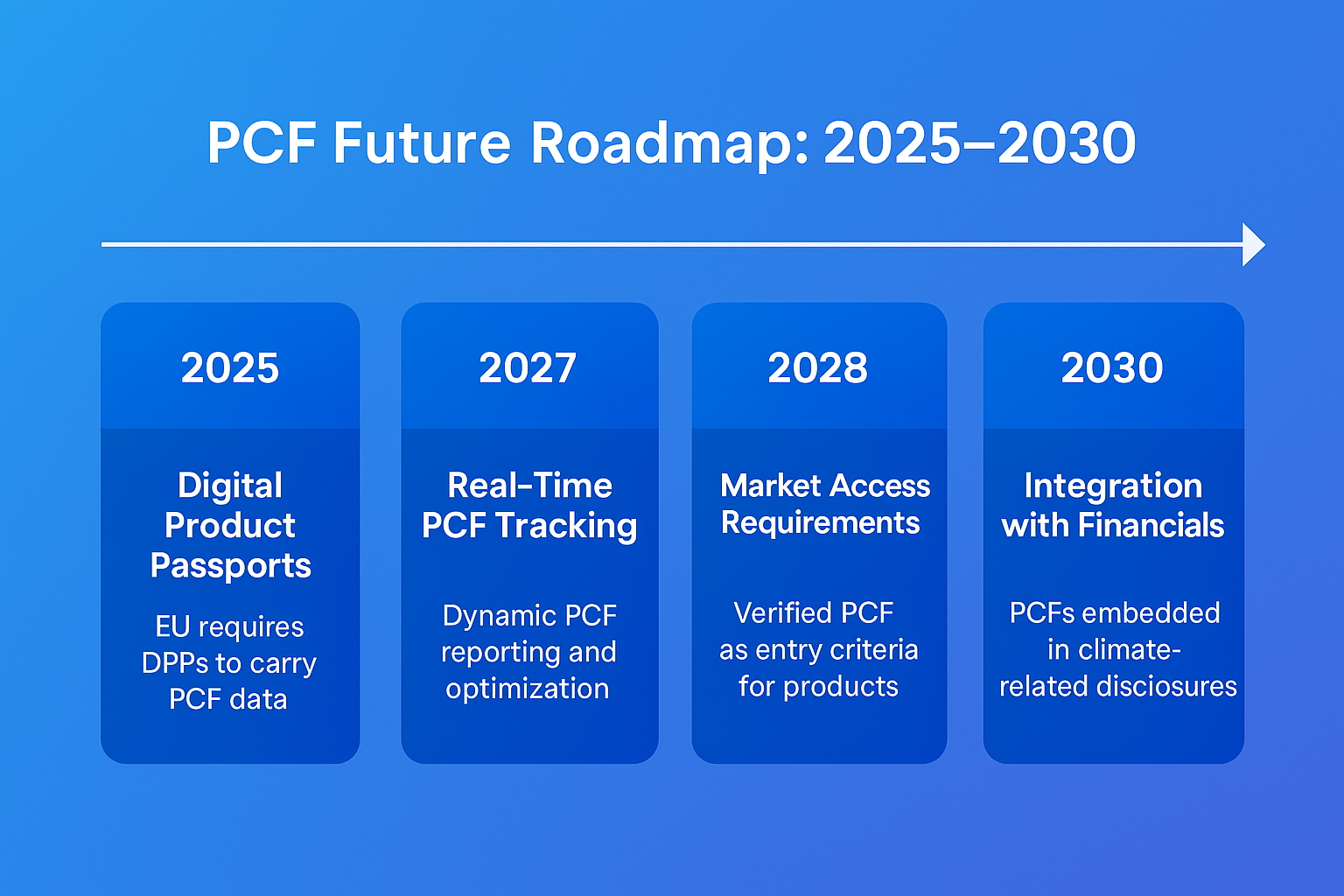
- Digital Product Passports (DPPs) Become Mandatory
- The EU’s Digital Product Passport initiative will require products to carry a verifiable record of their environmental impact, including PCF data, material composition, and recyclability.
- These DPPs will be embedded into products via QR codes or RFID tags, allowing consumers, regulators, and supply chain partners to instantly access sustainability information.
- Real-Time PCF Tracking and Dynamic Reporting
- Advances in IoT sensors, AI-driven analytics, and ERP integrations will enable continuous emissions monitoring rather than static, annual calculations.
- This means companies will be able to track and optimize PCFs in real time — identifying efficiency gains on the factory floor, adjusting supplier sourcing decisions on the fly, and instantly updating customer-facing disclosures.
- PCF as a Market Access Requirement
- Just as safety certifications became non-negotiable in the 20th century, verified PCF data will become a prerequisite for entering certain markets, securing contracts, or participating in sustainable procurement programs.
- Integration with Financial Decision-Making
- Carbon costs will increasingly be built into P&L statements through internal carbon pricing and mandatory climate-related financial disclosures under frameworks like IFRS S2.
- PCF data will no longer sit in a sustainability report — it will directly influence budgeting, pricing, and investment strategies.
Bottom Line
Companies investing now in AI-powered, integrated PCF systems like Credibl’s will not only stay ahead of compliance requirements but also position themselves as market leaders — winning customer trust, attracting ESG-focused investors, and creating operational efficiencies that competitors can’t match.
Frequently Asked Questions
- How is Product Carbon Footprinting different from corporate carbon footprinting?
Product Carbon Footprint (PCF) measures lifecycle emissions for a single product, while a corporate carbon footprint covers all operations. PCF offers the detailed insight needed for lifecycle carbon accounting and product-level decisions. - What standards are used for PCF reporting?
PCF reporting follows ISO 14067, the GHG Protocol Product Standard, and upcoming EU Digital Product Passport rules — all supported by Credibl’s PCF reporting software. - How can PCF data improve profitability?
Accurate PCF insights highlight cost and carbon “hotspots,” enabling material savings, process optimization, and competitive wins in sustainability-focused procurement. - Who needs to measure Product Carbon Footprints?
Manufacturers, brands in regulated markets, and companies targeting Scope 3 reductions or eco-labels benefit from batch-level carbon tracking and verified PCF data. - How does Credibl’s PCF Hub make the process easier?
It automates data capture from ERPs and suppliers, applies AI for real-time updates, and delivers audit-ready PCF reports aligned with global standards in weeks, not months.