





In a landmark move, the United Arab Emirates (UAE) has enacted the UAE Climate Decree 2025 (Federal Decree-Law No. 11 of 2024 on the Reduction of Climate Change Effects), which came into force on May 30, 2025. This sweeping legislation marks the region’s first legally binding climate law, signaling a significant shift in the MENA region from voluntary sustainability initiatives to enforceable climate mandates.
The decree is a critical step in the UAE’s long-term vision to achieve net zero emissions by 2050 and positions the country as a regional leader in climate governance.
For companies operating in the UAE, this is no longer about ticking boxes for CSR reports. It’s about embedding climate compliance into core operations, mitigating regulatory and reputational risks, and unlocking new opportunities in carbon markets and sustainable finance.
In this blog, we unpack what the UAE Climate Decree 2025 entails, who it applies to, what businesses must do to comply, and Credibl can help you prepare, respond, and lead with confidence.
What Is the UAE Climate Decree 2025?
The UAE Climate Decree 2025 is a federal law aimed at managing and reducing greenhouse gas (GHG) emissions, enhancing climate resilience, and supporting the UAE’s commitment to reach net zero by 2050. The law sets the stage for a unified, transparent, and enforceable climate governance framework.
Key objectives include:
- Establishing sector-specific GHG reduction targets
- Mandating emissions reporting and third-party verification
- Encouraging climate adaptation strategies across industries
- Promoting data transparency and national collaboration
Who Does the UAE Climate Decree 2025 Apply To?
The law applies to all public and private sector entities in the UAE, including those operating in free zones. Whether you’re a multinational corporation or a local SME, if your operations generate emissions, you’re likely subject to this regulation.
Entities emitting over 0.5 million tCO₂e annually (Scope 1 and 2) are required to:
- Register with the National Carbon Registry
- Report emissions based on ISO 14064 standards
- Submit data to third-party verification bodies
Smaller businesses are encouraged to participate voluntarily, especially if they are part of larger value chains affected by mandatory compliance.
What Are the Mandatory Requirements Under the UAE Climate Decree 2025?
- Mandatory Emissions Reporting
Companies must disclose Scope 1 and 2 emissions, and potentially Scope 3 in the future, using standardized methodologies. - Third-Party Assurance
Independent verification is required to ensure the accuracy and reliability of emissions disclosures. - Reduction and Adaptation Plans
Businesses must submit detailed emissions reduction and climate adaptation strategies aligned with national targets. - Climate Officer Appointments
Designating internal personnel responsible for overseeing climate risk and compliance is strongly encouraged. - Penalties for Non-Compliance
Fines range from AED 50,000 to AED 2,000,000, with repeat violations subject to increased penalties.
Why This Matters for UAE Businesses
- Compliance Is Now Mandatory: Voluntary reporting is no longer enough. GHG data must be accurate, auditable, and verified.
- Reputation at Stake: Failure to comply may lead to regulatory fines and reputational damage.
- Access to Carbon Markets: Registered entities can participate in the UAE’s National Carbon Credit Registry, opening up opportunities in voluntary and compliance markets.
- Investor Expectations: ESG data is increasingly critical to investment decisions. Transparent climate performance can attract sustainable capital.
How to Prepare for UAE Climate Decree 2025: A Business Compliance Guide
The UAE Climate Decree 2025 is making climate compliance a boardroom priority. Businesses that act early will not only stay on the right side of regulation but also gain strategic advantages in risk mitigation, access to capital, and stakeholder trust.
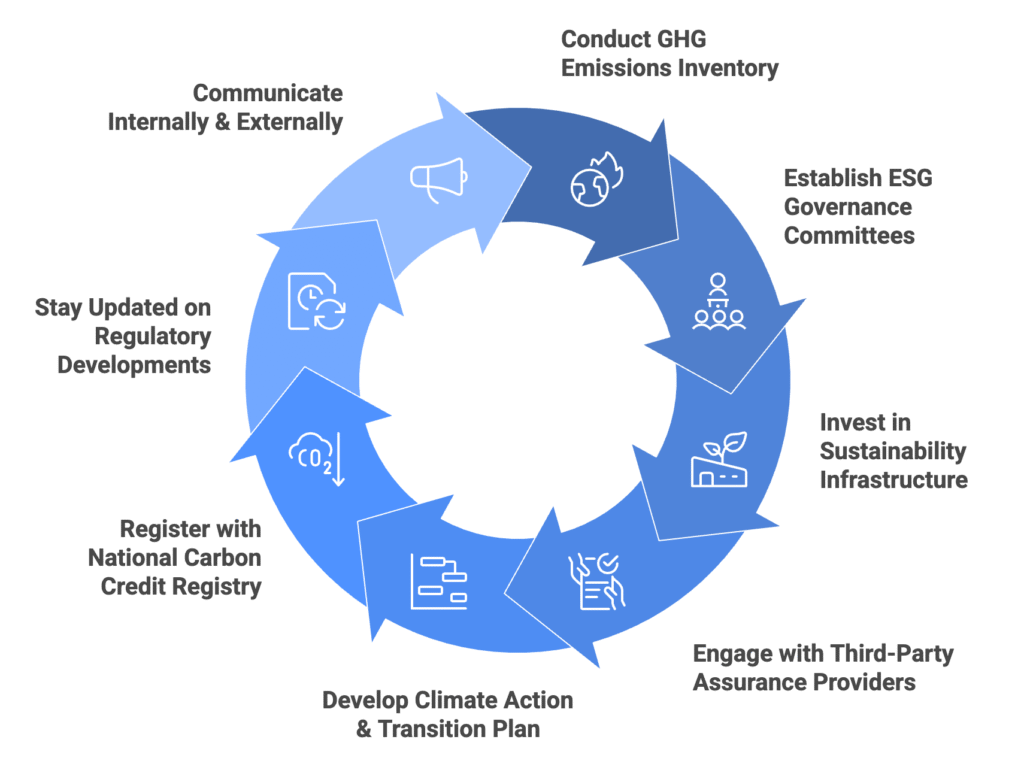
Here’s a step-by-step guide to help your organization get ready:
Step 1: Conduct a Comprehensive GHG Emissions Inventory
Start with establishing a baseline. Measure and document your Scope 1 (direct) and Scope 2 (indirect energy-related) emissions using internationally recognized methodologies such as ISO 14064. This will form the foundation of your compliance and reduction strategy.
- Identify all emission sources across facilities, operations, and energy usage
- Collect data from internal systems or external suppliers
- Ensure documentation is structured and auditable
Step 2: Establish ESG Governance and Accountability Structures
Assign clear roles and responsibilities for climate compliance within your organization. Many companies are appointing dedicated sustainability leads or climate officers to drive this agenda.
- Set up cross-functional climate committees or ESG task forces
- Ensure board-level oversight where applicable
- Provide training and resources for internal teams
Step 3: Invest in Sustainability Data Infrastructure
Manual spreadsheets won’t cut it. Invest in platforms that centralize ESG data, automate emissions tracking, and generate audit-ready outputs. These tools are critical for reducing administrative burden and avoiding compliance risks.
- Choose platforms that integrate with ERP, utility, and procurement systems
- Ensure support for ISO 14064 and UAE-specific reporting formats
- Enable real-time dashboards for internal monitoring and external disclosures
Step 4: Engage with Third-Party Assurance Providers Early
Third-party verification is a legal requirement for large emitters under the decree. Begin engaging accredited assurance partners early in the process to avoid bottlenecks closer to submission deadlines.
- Vet providers with experience in UAE climate regulations
- Run mock audits or pilot verifications for readiness checks
- Align internal documentation to third-party expectations
Step 5: Develop and Document a Climate Action & Transition Plan
Beyond reporting, the law requires businesses to outline how they will reduce emissions and adapt to climate risks. This should include both near-term and long-term strategies.
- Set emission reduction targets aligned with UAE national goals
- Identify abatement levers such as energy efficiency, renewables, and offsets
- Include adaptation measures for physical and transition risks
Step 6: Register with the National Carbon Credit Registry (if eligible)
Entities emitting over 0.5 million tCO₂e must register. This enables participation in carbon credit markets and ensures transparency in emissions accounting.
- Confirm your eligibility threshold.
- Prepare documentation for registration.
- Explore opportunities for offsetting via verified carbon credits.
Step 7: Stay Updated on Regulatory Developments
The UAE’s climate policy landscape is rapidly evolving. New sector-specific guidance expanded Scope 3 obligations, and updates to the National Carbon Registry are likely over time.
- Monitor updates from the Ministry of Climate Change and Environment (MOCCAE)
- Subscribe to regulatory briefings or ESG compliance alerts
- Stay aligned with both national and international reporting frameworks
Step 8: Communicate Internally and Externally
Use this transition as an opportunity to build engagement and transparency across stakeholders—from employees to investors to regulators.
- Publish sustainability goals and progress updates
- Align with investor ESG expectations
- Foster a culture of environmental responsibility across teams
What Makes Credibl the Right Partner for UAE Climate Decree 2025 Compliance
Credibl’s AI-powered sustainability data platform is purpose-built to support businesses navigating complex, evolving regulatory landscapes like the UAE Climate Decree 2025. Whether you’re a large emitter required to register with the National Carbon Registry or a mid-sized organization seeking to future-proof your operations, Credibl empowers you to stay compliant, audit-ready, and operationally efficient.
Here’s how Credibl can support your compliance journey:
- Automated GHG Data Collection & ISO-Aligned Calculations
Eliminate manual errors and fragmented spreadsheets. Credibl seamlessly integrates with your existing systems (ERP, utility data, procurement platforms) to automatically collect Scope 1 and 2 emissions data, with methodologies aligned to ISO 14064 and UAE regulatory standards. - Built-In Audit Workflows & Assurance Readiness
Ensure your sustainability disclosures can stand up to third-party scrutiny. Credibl offers built-in audit trails, evidence mapping, and data validation layers—so you’re not just reporting emissions, you’re demonstrating traceability and control. - Climate Risk Mapping
Go beyond compliance and start building resilience. Use Credibl’s scenario planning tools to assess physical and transition risks, model climate impacts, and stress-test your operations under different policy and market conditions. - Regulatory-Ready Reporting Modules
Generate structured, regulator-aligned disclosures at the click of a button. Credibl’s reporting templates are mapped to UAE national emissions targets, global frameworks (e.g., ISSB, TCFD), and investor expectations—helping you meet local compliance while aligning with international best practices. - Collaboration & Governance Features
Centralize sustainability governance with role-based access, team workflows, and dashboards designed for sustainability officers, finance teams, and external verifiers—all in one platform. - Future-Ready Flexibility
As UAE regulations expand to include Scope 3 disclosures and industry-specific targets, Credibl ensures you’re not playing catch-up. The platform is designed to scale with your compliance obligations and sustainability ambitions.
The UAE Climate Decree 2025 is more than a compliance mandate — it’s a catalyst for climate leadership in the region. As regulatory expectations rise, businesses that act early will gain a competitive edge in sustainability performance, risk management, and stakeholder trust.
Whether you’re a CFO, sustainability officer, or board member, now is the time to integrate climate into the core of your business strategy.